

Matching Storage Classes to Operational Commitments
Choosing a destination storage class requires matching the class to a minimum commitment that the organization can realistically sustain. Standard-IA and One Zone-IA are well-suited for steady, infrequent access but carry a 30-day minimum storage duration. For archival data, Glacier Instant Retrieval and Flexible Retrieval require a 90-day minimum, while Glacier Deep Archive is designed for multi-year cold storage with a 180-day minimum.
The choice of Glacier tiers offers significant cost reductions for data that does not need to be accessed in real-time. However, these tiers involve a trade-off: objects must be restored as a temporary copy before they can be accessed. Furthermore, transition paths are often one-way. For example, data can move from Flexible Retrieval to Deep Archive, but Deep Archive cannot be converted back to another class via Lifecycle rules. Miscalculating this can result in cold data being locked behind a manual restore process with no automated path back to high-availability tiers.
In contrast, S3 Intelligent-Tiering functions as a dynamic storage class rather than just a scheduling shortcut. It automatically moves data between three low-latency tiers with no retrieval charges and no fees for movement between those tiers. It also offers optional Archive and Deep Archive access tiers for data that can tolerate access delays of minutes to hours.
The Mechanics of Automation: Lifecycle Rules vs. Intelligent-Tiering
Understanding the distinction between Lifecycle rules and Intelligent-Tiering is essential for effective automation. Lifecycle is a scheduling mechanism that targets various storage classes based on a defined age schedule. In contrast, Intelligent-Tiering is a storage class with built-in monitoring and automation.
One nuance of billing involves the timing of transitions. For most classes, billing changes apply the moment a Lifecycle rule is satisfied, even if the physical movement of the data has not been completed. However, transitions into Intelligent-Tiering do not change the billing status until the object has physically transitioned. Conversely, transitions into Glacier tiers start the clock on the 40 KB per-object overhead and the minimum-duration penalty at the moment the rule is satisfied.
While Intelligent-Tiering removes the need for manual scheduling, it introduces a small monthly per-object monitoring and automation fee. For portfolios containing millions of small objects, this fee can accumulate into a substantial cost, even if retrieval itself remains free. Organizations must also be aware that tag-based Lifecycle evaluations run daily and updates can take time to propagate, meaning that removing a tag does not always immediately halt a queued transition.
Modeling Archive Retrieval and the Risks of Early Exit
Before committing to any storage class with a minimum duration, it is vital to model the frequency and urgency of data retrieval. Glacier Flexible Retrieval requests, for example, are metered in gigabytes, and the choice between Bulk and Expedited speeds can drastically alter both the cost and the wait time.
Early-exit exposure is another common pitfall. Deleting, overwriting, or transitioning an object before its class’s minimum duration is met triggers a prorated fee for the remainder of that period. Whether a single early restore operation negates the projected savings of a tiering strategy depends on the object size and the volume of data retrieved. This is a calculation that must be performed as a break-even model rather than relied upon as a fixed outcome.
 Enterprise Tech & Infrastructure
IonQ Breakthrough Demonstrates Real-Time Quantum Error Correction Using Standard CPU Architecture
The global pursuit of fault-tolerant, scalable quantum computing has long been defined...
 Enterprise Tech & Infrastructure
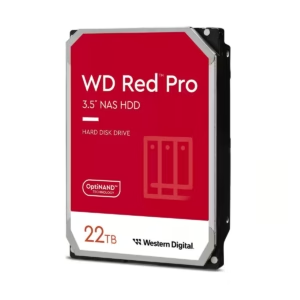
Seagate, Western Digital, and Toshiba Lead 2023 Rankings for Enterprise-Grade Storage Solutions
In the rapidly evolving landscape of corporate data infrastructure, the demand for...
 Enterprise Tech & Infrastructure
Understanding Fibre Channel over Ethernet: Bridging the Gap Between High-Performance Storage and Ethernet Ubiquity
In the rapidly evolving landscape of data center infrastructure, the quest for...







