

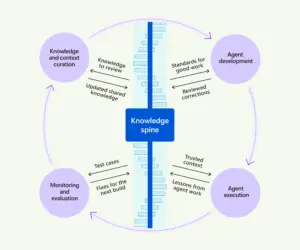
A significant portion of Microsoft’s platform development is now dedicated to the creation and management of AI agents. Unlike simple chatbots, agents are designed to perform complex, multi-step tasks with a degree of autonomy. Spataro points out that the deployment of an agent is not the end of the process, but rather the beginning of a lifecycle. The organizations that succeed in this new era will be those that establish "continuous improvement loops." By defining what "good work" looks like and measuring agent performance against those benchmarks, businesses can incrementally refine their AI tools. Microsoft is building these feedback loops directly into its products, allowing for a compounding effect where small, data-driven improvements eventually lead to an agent that outperforms any initial specification.
Business Model
One of the most significant challenges facing modern business leaders is the management of AI-related costs. For the better part of two decades, the software-as-a-service (SaaS) industry has relied on the User Subscription License (USL)—a predictable, flat monthly fee per employee. While this model provided financial stability for both vendors and customers, the advent of generative AI has introduced a level of computational intensity that traditional subscription models struggle to accommodate.
Spataro identifies a common pitfall in current enterprise thinking: trying to apply the logic of traditional software licensing to the high-compute world of AI agents. To address this, Microsoft is introducing a bifurcated economic model that balances predictability with the realities of usage-based costs.
The first component remains the traditional subscription. The Copilot USL provides employees with a comprehensive productivity experience, including chat capabilities, integration across Microsoft 365 apps, and access to ready-made agents like "Researcher" and "Analyst." This ensures that every employee has a baseline level of AI access at a fixed price, even as the underlying intelligence of the system improves.
The second component is a shift toward usage-based billing (UBB). This model is tied to the actual volume of work performed by AI agents rather than the number of human users. Spataro argues that for long-running, complex jobs, a flat fee is no longer sustainable. He reframes these costs not as traditional overhead, but as capital investment. Just as a company invests in headcount to build capability, it must now invest in "agentic" capacity.
To simplify this complexity, Microsoft is introducing "Copilot Credits." This serves as a shared currency across the platform, aggregating various AI operations into a single meter. This approach is intended to give businesses complete visibility into their spending. By allowing organizations to set limits and monitor consumption in real-time, Microsoft aims to eliminate the "bill shock" that often accompanies high-scale AI deployments, ensuring that financial controllers have the tools to manage budgets before an invoice is generated.
 Productivity Software & Office Suites
Microsoft Shifts Focus to Enterprise AI Utility: A New Strategic Framework for Agents, Economics, and Partnership
In an era defined by a relentless cycle of artificial intelligence breakthroughs,...
 Productivity Software & Office Suites
Microsoft Shifts AI Strategy Toward Agentic Workflows and Hybrid Economic Models
In a comprehensive communication addressed to customers this week, Microsoft’s Chief Marketing...
 Productivity Software & Office Suites
The Agentic Edge: New Research Reveals the ‘Knowledge Spine’ Powering the World’s Most Advanced AI Enterprises
In the rapidly evolving landscape of corporate technology, the conversation among C-suite...







