
Expand what you can build
The technological toolkit available to modern enterprises is becoming increasingly powerful and interconnected. This evolution presents a unique opportunity for organizations to move away from improving single steps in a process and instead focus on end-to-end transformation. The traditional approach of addressing "siloed" tools—where an app does one thing and a database does another—is being replaced by a holistic view of the business process.
To illustrate this shift, Microsoft points to the procurement process, a standard but often friction-heavy operation in most large enterprises. In a modernized, AI-integrated version of this process, the journey begins with an employee making a simple request through Copilot. From there, an AI agent takes over the labor-intensive task of gathering relevant supplier information and cross-referencing it with internal purchasing policies.
The underlying application then applies the necessary data models, verifies permissions, and triggers approval rules. A structured workflow routes the request through the appropriate channels, handling routine administrative steps automatically. Crucially, the system is designed to identify higher-risk exceptions, which are then routed to a human professional for review. This "human-in-the-loop" model ensures that while AI handles the volume and the routine, people remain in control of the critical decisions that require nuanced judgment.
Building these types of sophisticated solutions requires a convergence of skills that were previously kept separate. Business experts, who understand exactly where a process tends to break down, must work alongside developers who connect the technical systems. Simultaneously, administrators must establish the guardrails, ensuring that the entire operation remains responsible, secure, and governable.
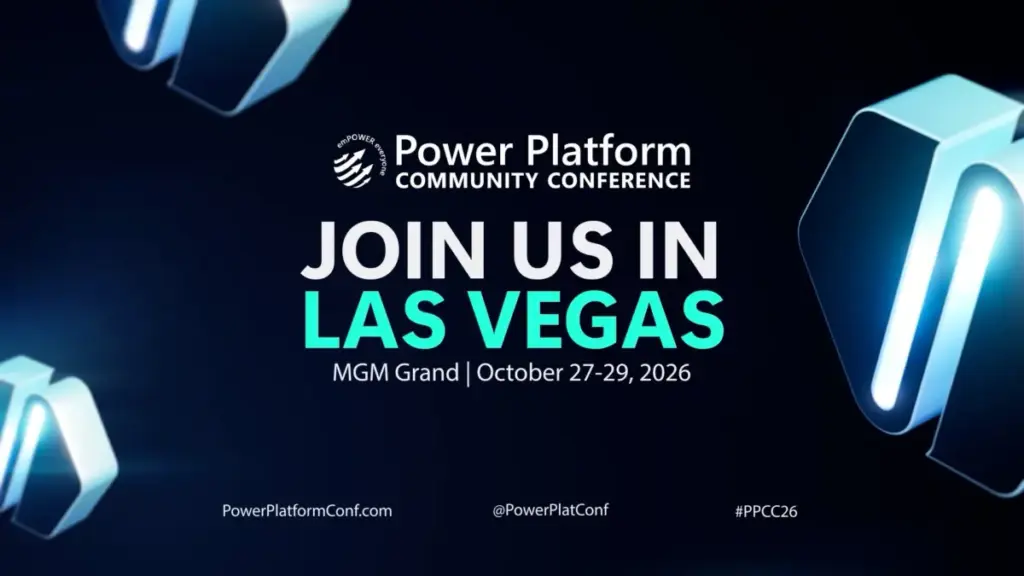
A key initiative for the 2026 conference is the "bring one process" challenge. Microsoft is encouraging every participant to arrive with one specific process that is vital to their organization. Throughout the event, attendees will have the opportunity to work with product teams and community members to dissect these processes. The goal is to leave Las Vegas not just with theoretical knowledge, but with a practical plan to apply Copilot, agents, and automation to a real-world problem. This incremental approach—starting with one meaningful process, learning from it, and then scaling what works—is designed to prevent the "analysis paralysis" that often accompanies large-scale digital transformations.
Plan your PPCC week
The Power Platform Community Conference is structured to provide a comprehensive roadmap for organizations at various stages of their AI journey. The event will kick off with an opening keynote on October 27, featuring Charles Lamanna, Executive Vice President at Microsoft, along with other senior leaders. The keynote is expected to unveil the next phase of development for Copilot and agents, specifically focusing on how these technologies are fundamentally altering the "build" experience for both professional and citizen developers.
 Productivity Software & Office Suites
Microsoft Unveils Reimagined Copilot with Agentic Capabilities and New "Autopilot" Digital Teammate
Microsoft has announced a sweeping overhaul of its Copilot platform, signaling a...
 Productivity Software & Office Suites
Microsoft Reimagines Copilot as a Central Hub for Autonomous AI and Agentic Work
Microsoft has announced a significant evolution of its AI strategy, unveiling what...
 Productivity Software & Office Suites
Microsoft Unveils Strategic Roadmap for Enterprise AI, Prioritizing Agentic Workflows and Flexible Economic Models
In an era defined by rapid-fire technological breakthroughs and a relentless cycle...







