

Matching Storage Classes to Access Patterns
Choosing the right destination storage class requires a balance between cost savings and the minimum commitment an organization can tolerate. Each class is designed for a specific "break-even" point. S3 Standard-IA and One Zone-IA are ideal for steady, infrequent access but come with a 30-day minimum storage duration. If objects are deleted or moved before this window closes, AWS applies a prorated fee for the remainder of the duration.
For long-term archives, the Glacier family offers deeper discounts but higher complexity. Glacier Instant Retrieval and Flexible Retrieval require a 90-day minimum commitment, while Glacier Deep Archive—the lowest-cost tier—requires 180 days. It is important to note that data in Flexible Retrieval and Deep Archive is not available in real-time. A temporary copy must be restored before the data can be accessed, a process that can take anywhere from minutes to hours depending on the retrieval tier chosen.
Furthermore, transition paths for these cold tiers are often one-way. While data can move from Flexible Retrieval to Deep Archive via Lifecycle rules, the reverse is not possible through automation. Miscalculating the need for data access can lock critical information behind a slow and potentially expensive restore process with no automated path back to warmer storage.
Automation Strategies: Lifecycle Rules vs. Intelligent-Tiering
The choice between manual Lifecycle rules and Intelligent-Tiering is often framed as a competition, but the two are actually complementary mechanisms. Lifecycle is a scheduling engine; it targets specific classes based on the age of the object. Billing changes for these transitions typically apply the moment a rule is satisfied, even if the physical movement of the data is still in progress. However, there are nuances: transitions into Glacier tiers begin the 40 KB per-object overhead and the minimum-duration clock at the moment of rule satisfaction, not at physical completion.
S3 Intelligent-Tiering, on the other hand, is a storage class with built-in automation. It moves data between three low-latency tiers (Frequent, Infrequent, and Archive Instant Access) based on access patterns, without retrieval charges or fees for internal movement. For data that may not be touched for months but must be available in milliseconds when requested, it is often the most resilient choice.
The trade-off for this automation is a monthly per-object monitoring and automation fee. While AWS describes this fee as "small," it can become a significant expense for portfolios containing millions of objects. Organizations must also be aware that tag-based Lifecycle evaluations run daily, and updates can take time to propagate. Removing a tag does not guarantee an immediate halt to a queued transition, requiring a level of patience and foresight in governance.
Modeling Archive Retrieval and the Risk of Early Exit
 Enterprise Tech & Infrastructure
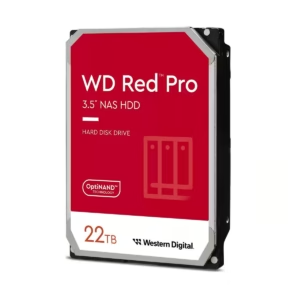
The Pillars of Data Infrastructure: A Comprehensive Evaluation of the Top Enterprise Hard Drives for 2023
In the modern landscape of digital infrastructure, the demand for robust, high-capacity...
 Enterprise Tech & Infrastructure
Navigating the Hidden Complexities of Amazon S3 Cost Management
For many enterprise IT departments, the monthly Amazon Web Services (AWS) bill...
 Enterprise Tech & Infrastructure
Navigating the Financial Realities of Enterprise Cloud Storage: A Comprehensive Analysis of Amazon S3 Cost Management
In the rapidly evolving landscape of enterprise cloud infrastructure, the management of...







