

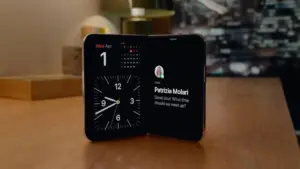
Simultaneously, Apple is actively refining its newer form factors. Following the launch of the original iPhone Duo, reporting indicates that engineering teams are already working through four primary upgrade objectives for future iterations of the device:
- Integrating true hardware Face ID functionality onto the outer display.
- Incorporating a dedicated Action button.
- Adding an optical telephoto camera lens.
- Achieving a noticeably thinner and lighter overall chassis design.
While Apple has already constructed functional iPhone Duo 2 prototypes featuring outer-display Face ID modules, engineering constraints have created a tight timeline for finalizing the component layout. As an interim software solution, Apple introduced a camera-based facial unlock feature in the second beta of iOS 27.3 for current iPhone Duo hardware. This option allows users to unlock the device from the Lock Screen using the standard front-facing camera, though secure transactions—such as Apple Pay purchases and password authentications—still strictly require Touch ID verification. Full, hardware-grade Face ID on the outer panel remains slated for upcoming hardware revisions as Apple optimizes the physical layout.
Next-Generation Wearables: Smart Glasses and Camera-Equipped AirPods Pro
Beyond traditional mobile devices, Apple is preparing to broaden its personal computing footprint through major innovations in its wearables division. Headlining this effort is the anticipated debut of all-new Apple smart glasses, representing the company’s first lightweight head-worn visual interface.

Unlike heavy virtual reality headsets, the smart glasses are designed around ambient, everyday utility. The hardware will heavily rely on deep Apple Intelligence and Siri AI app integrations to deliver contextual information, real-time visual navigation, hands-free notifications, and audio interactions directly to the user. This software-driven approach aims to create a subtle display layer powered primarily by proximity processing from a paired iPhone.
Accompanying the smart glasses in the 2027 wearables pipeline are next-generation AirPods Pro models featuring integrated camera modules. These miniaturized, low-power camera sensors are designed to expand the spatial awareness of Apple’s audio accessories. By capturing real-time visual data from the wearer’s surroundings, the new AirPods Pro will feed information into Apple Intelligence algorithms, enabling enhanced situational awareness, context-aware visual processing, and improved spatial audio positioning tailored dynamically to the user’s immediate environment.
Smart Home Expansion: Scaling Up the HomeView Architecture
Following the commercial release of the original HomeView, Apple is already looking to expand its footprint in smart home hardware. The initial HomeView launch proved foundational, establishing a dynamic display platform capable of recognizing home occupants and tailoring Siri AI interactions based on user identity and context.
To build on this foundation, Apple is reportedly developing a larger-screen variant of the HomeView scheduled for a 2027 release. Designed to act as a more prominent visual command center for larger living spaces, kitchen counters, or dedicated wall installations, the expanded model will feature enhanced display real estate to accommodate richer multi-widget interfaces, video calling options, home security monitoring feeds, and media playback controls simultaneously.
 macOS & Apple IT Support
Supposed M6 Pro Geekbench Result Flawed and Likely Fake, Founder Confirms
A benchmark score claiming to reveal the performance capabilities of an unreleased...
 macOS & Apple IT Support
Apple Retail Staff Advised to Warn Walk-In Customers Against Launch-Day Visits as iPhone Duo Supply Shortages Deepen
Apple retail employees have been instructed to proactively warn customers against visiting...
 macOS & Apple IT Support
Apple Details Workaround for Apple Watch Daylight Saving Time Display Glitch
Apple has officially published a support document addressing a software issue that...







